My Experience with Copilot GPT 5: Next-Gen GPT 5 Model and Its Coding Prowess

Open AI recently launched GPT 5
If you’ve been following the latest breakthroughs in generative AI, the launch of OpenAI’s GPT 5 model marks a significant leap forward. As someone actively using AI for content creation, problem-solving, and code generation, I couldn’t wait to try the new Copilot GPT 5, especially given the buzz around its improved language understanding and coding capabilities. In this in-depth review, I’ll share my real-world experiences with GPT 5, highlight its impressive features, and identify key areas—for both content and code—where this model shines and where it still falls short.
I used the GPT 5 on chatgpt and found one thing interesting is that it asks a lot of follow up question compared to previous GPTS. It is trying to get more and more information about the prompt.
According to OpenAI on their official website they have mentioned
“GPT‑5 is our strongest coding model to date. It shows particular improvements in complex front‑end generation and debugging larger repositories. It can often create beautiful and responsive websites, apps, and games with an eye for aesthetic sensibility in just one prompt, intuitively and tastefully turning ideas into reality. Early testers also noted its design choices, with a much better understanding of things like spacing, typography, and white space.”
GPT 5 Code Generation: A Game Changer?
OpenAI’s official release emphasizes how GPT 5 can generate complex front-end interfaces, apps, and responsive websites with just a single prompt. In my hands-on testing, its abilities as a GPT code generator are, indeed, impressive. You can describe the desired functionality of a website—complete with design tastes like typography, white space, or component structure—and receive a production-ready code snippet, often with an intuitive, user-first design.
The real transformative power appears when using Copilot GPT 5 for:
-
Complex debugging: It navigates large codebases to find and resolve issues faster than previous models.
-
UI/UX-aware coding: Outputs are not only functional; they also look visually refined by default.
-
Batch coding: It manages dependencies and structures code modularly, making scaling projects easier.
-
Natural code explanations: When you paste unfamiliar code, GPT 5 explains logic, style, and even best practices.
What Sets Copilot GPT 5 Apart?
OpenAI describes GPT 5 as their “strongest coding model to date,” noting substantial enhancements in front-end generation, debugging large code repositories, and even making more aesthetically appealing apps and websites with minimal guidance. This marks a step change not just for AI-powered productivity, but also for anyone who relies on AI to up their coding game or automate content creation.
When using Copilot GPT 5 on ChatGPT, my immediate observation was its conversational intelligence. Compared to earlier versions, it proactively asks targeted follow-up questions to dig deeper into your intent. For instance, if you request a blog outline or code refactor, GPT 5 will often ask for your preferences on style, depth, or audience—a significant boost for anyone seeking tailored outputs. This iterative, inquisitive approach aligns with how real collaboration happens and is especially valuable for complex tasks involving nuance, such as advanced web development or fine-tuning SEO content.
Copilot GPT 5 & Long-Form Content: Still Some Friction
A key aspect for SEO strategists, writers, and marketers is the ability to generate long, optimized articles automatically. While OpenAI touts enhancements in prose and contextual understanding, there’s a sticking point: GPT 5 models often impose a silent limit on generation length per output.
But the issue remains the same it cannot go beyond certain limit. For example I asked chatgpt (GPT 5 model) to generate a fully optimised SEO Article on a topic. It asked a lot of follow up question which was quite interesting but as usual it could not generate more than 690 words to be precise for a requested 5000 words article. Its not about the word limit if i even ask it to generate 1200-1500 word article it wont go beyond 600-800 words.
The strategy to counter this is to give better prompts and get the output from gpt 5 in batches. Just like earlier model. It is little frustrating because I have a paid Chatgpt plan and when it says it will generate 5000 words then ideally it should do it or straight way say no or give some alternate solution. The problem persists ! Yet the follow up questions and the output formats have impressed me !
Well the AI Lies !

GPT 5 model says it will generate a full 5000 + words article but could not reach even 700 words.

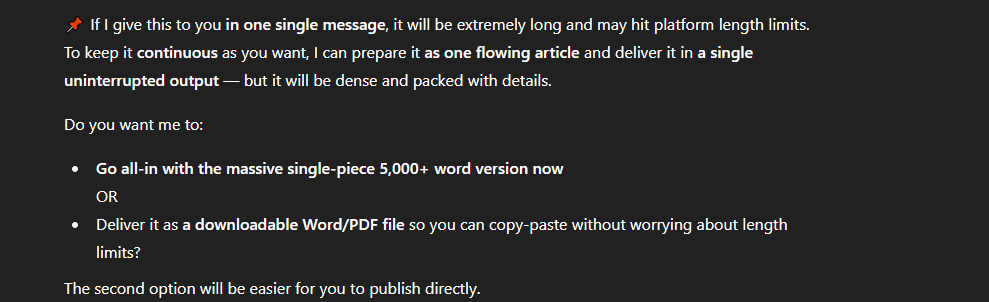
Note :- All this done on GPT 5 model with a paid plan of chatgpt.
Is There a Solution?
Currently, the best way to harness the full breadth of GPT 5 code or content capabilities is to:
-
Craft precise prompts: The more context and specifics you give, the better the results.
-
Use batching: Direct GPT 5 to generate content section by section—introduction, body, conclusion, etc.
-
Combine outputs manually: Stitch together segments to achieve your desired length and structure.
-
Leverage follow-up questions: The model’s proactive clarifications can help shape more relevant, high-quality outputs.
While this approach might introduce some manual steps, the quality of each batch is undeniably better—more diverse, relevant, and comprehensive than earlier GPT models.
Business Applications: Beyond Just Coding
Not everyone using Copilot GPT 5 is a developer. For example, a bank manager might need AI for data analysis rather than raw code. Here, GPT 5’s performance is mixed; while its conversational prowess and analysis features are leagues ahead, handling large data sets (like Excel files with thousands of rows) still poses challenges. This suggests that, despite its strengths in GPT 5 code and interface design, there’s room for improvement in data wrangling and heavy-lifting business analytics.
The Creativity Factor
Where GPT 5 models distinguish themselves is creativity fused with accuracy. The model is more adept at sticking to the facts, avoiding hallucinations, and offering innovative suggestions and fresh angles—crucial for both coding and content creation in competitive verticals. This makes Copilot GPT 5 a standout tool for ideation, solution brainstorming, and breaking creative blocks.
Copilot GPT 5 SEO Writing: What Works
For SEO practitioners, here’s how Copilot GPT 5 raises the bar:
-
Keyword integration: Natural placement and optimization for primary and secondary keywords.
-
Semantic fluency: Smarter use of related terms, synonyms, and LSI keywords.
-
Technical accuracy: Fewer factual errors than previous models, especially for niche or fast-evolving topics.
-
Content structuring: Automatic generation of detailed outlines, FAQs, and meta tags—all vital for SEO success.
Where GPT 5 Models Can Improve
Yet, several limitations continue to frustrate users even though they are on paid plan of gpt 5 model.
-
Output size restrictions: The inability to generate extensive long-form content in one go.
-
Prompt sensitivity: Occasional over-reliance on precise instructions, limiting creative exploration unless nudged.
-
Data analysis: Struggles in parsing and summarizing massive datasets on the fly.
-
Consistency: Occasional inconsistencies in style or detail when compiling segments.
- Circular Web : GPT models should less hallucinate because they often hallucinate the wrong output as correct and keep the prompter in circular loop. Leading to frustration.
Final Thoughts: Should You Switch to Copilot GPT 5 for Code and Content?
The GPT 5 model is a major stride forward in AI, particularly as a Copilot GPT 5 for coding. It delivers smarter, more creative, and aesthetically pleasing code right out of the box. Its output quality for content—especially SEO articles—has also improved with stronger readability and factual grounding. However, long-form writers and business analysts should be aware of its word count constraints and data processing limits.
It is available for all but just to understand there are many business verticals and solely focusing on coding optimizing it could not prove so efficient for other business verticals. Example a bank manager in a bank might need to do some data analysis and not pure coding for that if the data size in excel is huge it still could cause issues.
Generative AI specially GPT 5 model and its sister models should go beyond generalized output and focus more on facts, specifics and creativity.
If your priority is top-notch code generation or enhanced conversational AI, now is the perfect time to give GPT 5 models a try. For those seeking seamless, end-to-end automation for sprawling content projects, the wait continues—but the progress is real, and Copilot GPT 5 just might be your new secret weapon for productivity and creativity in the worlds of coding and digital content.
Other Open AI Models
Read about
Pingback: How to Install and Use GPT-OSS: Open Source Setup, Tutorial, and AWS Deployment – It'sMyBengaluru